ScientiaHubDiscuss your project

Book development · Demonstration study

A book with a reader promise, not just a subject

Follow an original nonfiction concept from its premise to chapter architecture, opening prose and evidence ledger.

The brief

What needs to change?

Develop A Field Guide to Better Questions, an unpublished illustrative book concept for professionals making decisions from incomplete evidence. The following reader brief, chapter sequence and original opening were created for this website.

The challenge

A large subject is not yet a book. The manuscript needs a specific reader, a reason to continue and a clear distinction between evidence, advice and an illustrative scene.

Working excerpt · Illustrative material

Concept brief and original manuscript excerpt

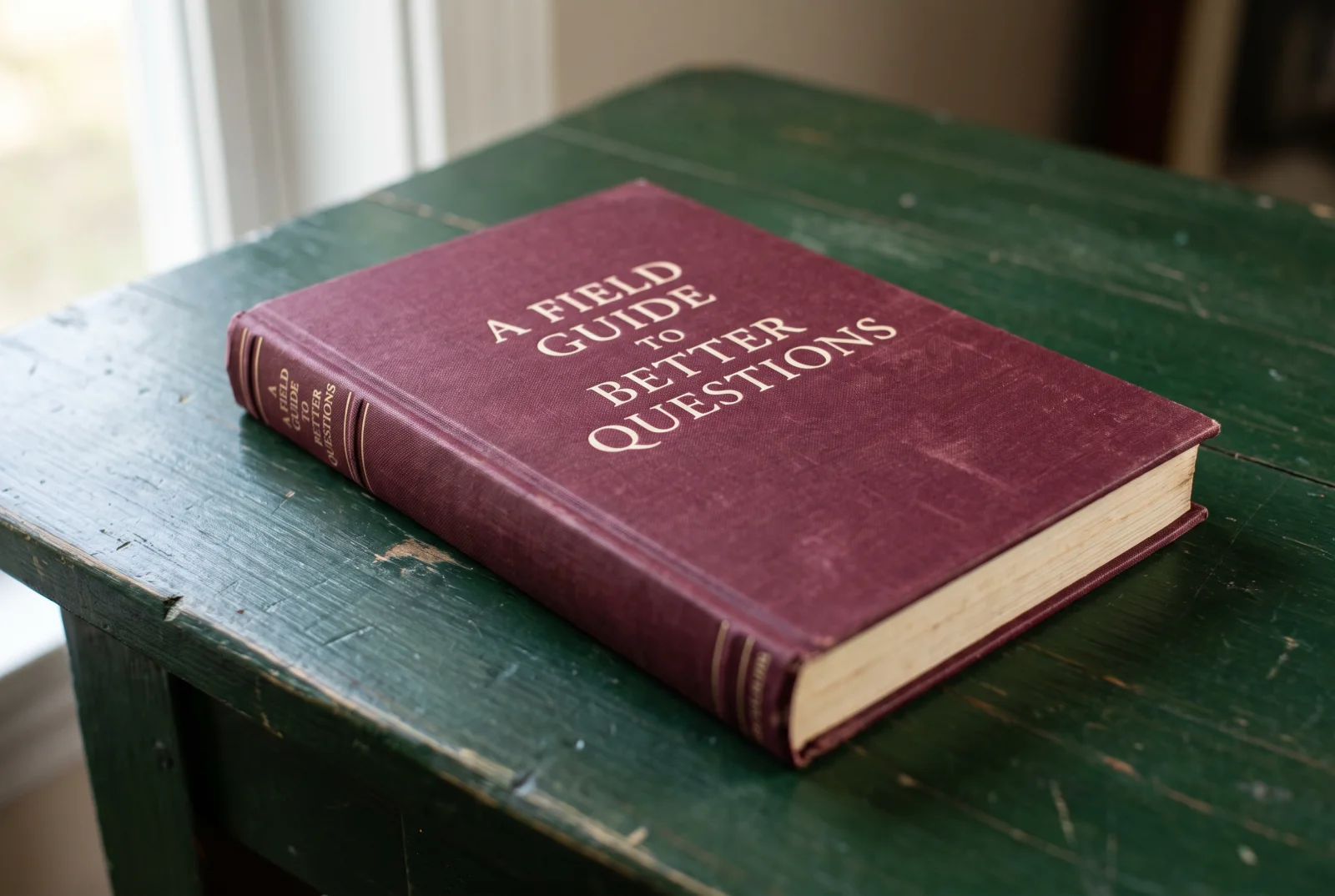
Illustrative burgundy cloth cover titled A Field Guide to Better Questions
AI-generated cover concept · Unpublished demonstration · Adobe Firefly
Development ledger · What the opening asks the rest of the book to earn
ElementEditorial purposeDevelopment action
Meeting-room sceneGive an abstract problem a recognisable setting.Keep it explicitly fictional; do not attribute it to an actual organisation.
Confidence and performanceShow how a claim can grow beyond its measure.Use a clearly identified worked example; source any general empirical claims separately.
Known / Open / NextTurn uncertainty into a practical decision record.Test the device against contrasting chapter scenarios rather than repeat it mechanically.
Review triggerEnd with a decision the reader can revisit.Specify what new information would change the decision.

01 / State the reader promise

For readers who have information but need a clearer basis for action. The intended book helps them distinguish a question from an assumption, identify what a claim depends on and explain what would change their mind. This is a proposed reading experience, not a guaranteed result or a market-demand finding.

02 / Build a continuous journey

1. Whose result? Establish the population and denominator. 2. Compared with what? Examine the alternative behind a claim. 3. What changed? Distinguish measurement from explanation. 4. What would change our minds? Specify disconfirming evidence. 5. When do we look again? Turn the argument into a decision record and review trigger.

Original opening · Fictional scene

Whose result?

The last slide showed a rise in confidence. Beneath the chart, in smaller type, was a note: responses received. Around the table, the result had become a statement about everyone who had attended the programme. Nobody had announced that change. It happened between the chart and the conversation.

Someone turned back a page. How many had attended? Which people had replied? Were the same people answering before and after? The chart could not answer. It had been built to display a result, not to carry the history of how that result was made.

The decision did not need to be abandoned. It needed a different sentence: here is what we know, here is what remains open, and here is the next piece of evidence worth obtaining.

The chair wrote three headings on the reverse of the agenda. Under “Known”, she put the result among respondents. Under “Open”, she put the people who had not replied and the absence of a comparison. Under “Next”, she wrote a question rather than a recommendation: what would we need to observe before extending the programme?

That record did not remove the disagreement in the room. It made the disagreement easier to locate. One colleague was concerned about cost; another wanted stronger evidence of benefit. They had been using the same word—success—for different decisions. Now they could ask what information each decision required, and whether waiting for it would change what they could reasonably do today.

This book begins at that small change in language. A useful question gives uncertainty a place in the work. It helps us decide whether to proceed, look again, or ask for something the current evidence cannot provide. Before the next meeting, there is one thing to write down: what would make us reconsider?

04 / Separate claims from illustrations

Evidence ledger: “Asking narrower questions improves team decisions” → empirical claim needing appropriate evidence; not ready for assertion. Opening meeting → original fictional illustration; retain its label. “Record a review trigger” → proposed practice with rationale; do not disguise it as a proven universal rule. No invented citation fills an evidence gap.

05 / Record editorial decisions

Voice note: direct, observant and precise. Use concrete decisions before abstract terminology. Address the reader as you when proposing an exercise. Keep claim, evidence and decision distinct. Close each chapter with a question that creates the need for the next. A real author's sample material would set the voice in a commissioned manuscript.

Read alongside the reasoning and limitations below. These excerpts are not a complete commissioned deliverable.

Editorial & methodological judgement

Why these decisions?

The value is in the choices that connect the brief to the result.

Reader before inventory

Organise material around the reader's changing understanding, not the order in which notes were collected.

Evidence without borrowed authority

An engaging example can illustrate an idea without pretending to verify it. Empirical assertions remain in the sourcing ledger until supported.

A distinctive voice with continuity

Record choices about rhythm, terminology and address so that a longer manuscript sounds like one coherent work, while respecting the author's own perspective.

Review checklist

What to check.

  • Every chapter has a distinct narrative purpose.
  • The opening fulfils the stated premise.
  • Empirical claims, advice and fiction are distinguishable.
  • Terminology remains consistent without flattening the voice.

A possible commissioned handover

What to specify.

  • Positioning and reader brief
  • Five-chapter architecture
  • Original opening excerpt
  • Evidence-ledger and voice/style notes

The actual deliverable list, format and review stages are agreed in your quote.

Bring your own brief

Make the next step specific.

Explore this service See what your quote includes Discuss your project

Another kind of work

Understand the calculation. Then challenge the conclusion.

Read the next demonstration Back to all demonstrations